Read slide text
OPENSIZE · 01 / 18
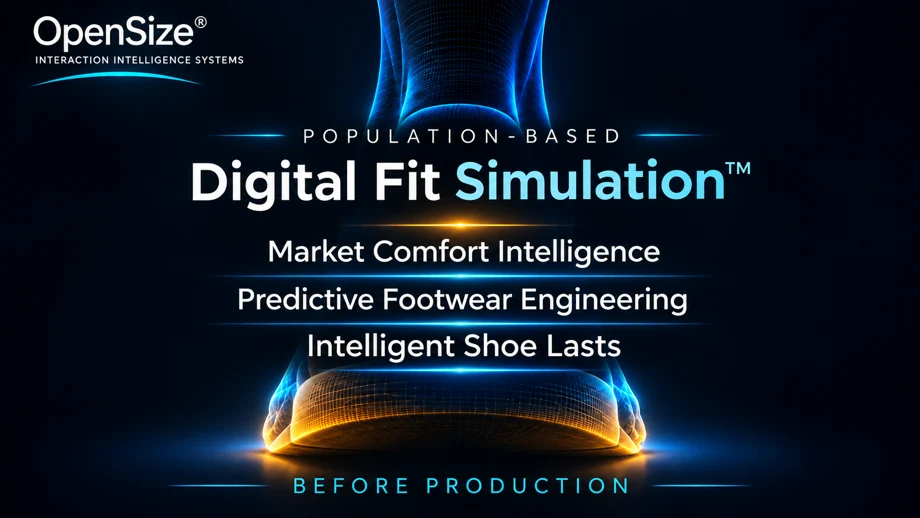
Digital Fit Simulation™
Population-Based Digital Fit Simulation. Before Production.
Market Comfort Intelligence
Understand comfortable-fit coverage across the target population.
Predictive Footwear Engineering
Design and refine footwear geometry before physical production.
Intelligent Shoe Lasts
Turn population fit intelligence into better last designs.
Read slide text
OPENSIZE · 02 / 18
Predictive Engineering for Footwear
From digital fitting to engineering decisions.
Digital Fit Simulation
Model foot–shoe interaction across target populations.
Market Comfort Intelligence
See the distribution of comfortable fit across your market.
Data-Driven Engineering
Design and optimize shoe lasts for your market.
Read slide text
OPENSIZE · 03 / 18
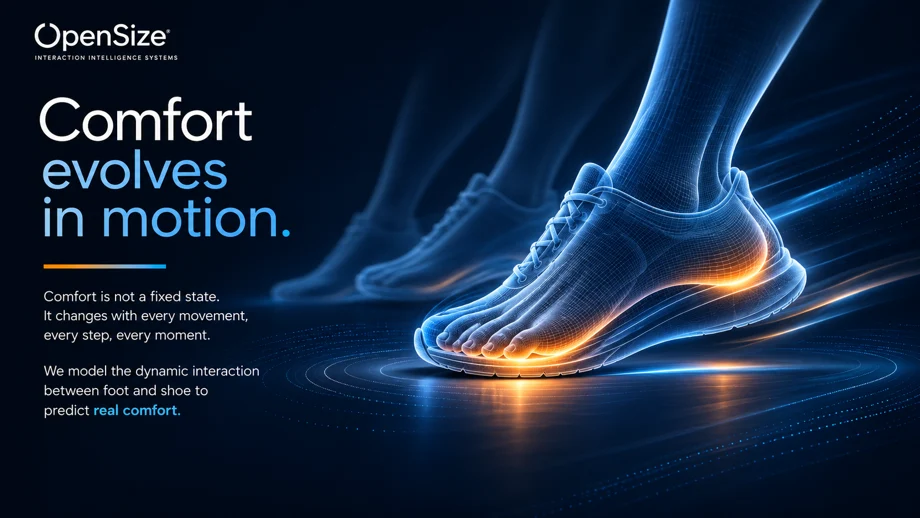
Comfort evolves in motion
Comfort is not a fixed state. It changes with every movement, every step, every moment.
Dynamic interaction
We model how the foot and shoe interact during motion.
Comfort prediction
Foot–shoe interaction data supports precise comfort diagnostics.
Read slide text
OPENSIZE · 04 / 18
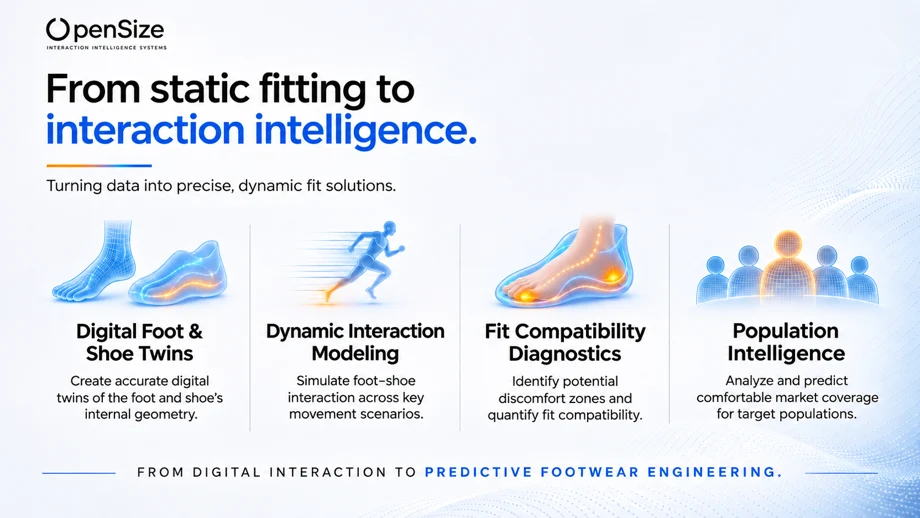
From static fitting to interaction intelligence
Turning data into precise, dynamic fit solutions.
Digital Foot & Shoe Twins
Create accurate digital models of the foot and the shoe’s internal geometry.
Dynamic Interaction Modeling
Simulate interaction during key movement scenarios.
Fit Compatibility Diagnostics
Identify discomfort zones and quantify fit compatibility.
Population Intelligence
Analyze comfortable-fit coverage across the target population.
Read slide text
OPENSIZE · 05 / 18
How We Do It

Read slide text
OPENSIZE · 06 / 18
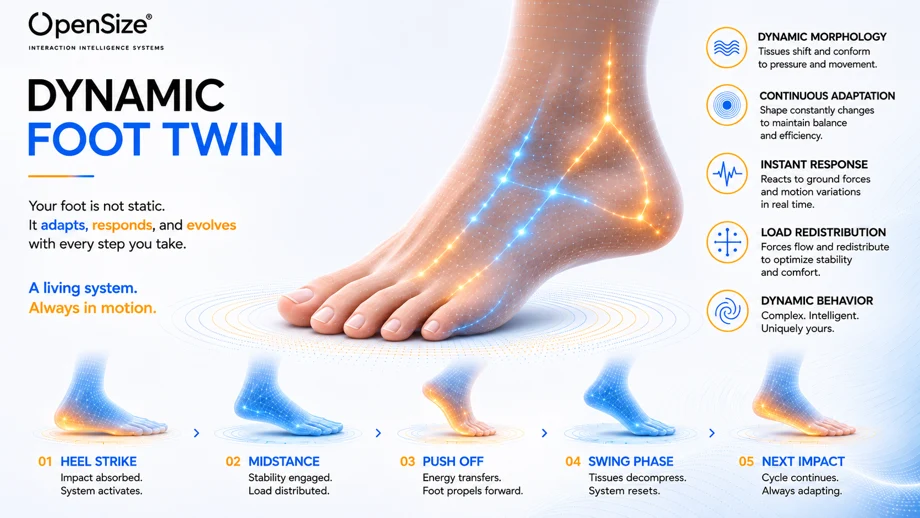
Dynamic Foot Twin
Your foot is not static. It adapts, responds and evolves with every step you take.
Dynamic morphology
Tissues shift and conform to pressure and movement.
Continuous adaptation
Shape changes throughout the movement cycle.
Instant response
The foot responds to ground forces and motion.
Load redistribution
Forces shift across anatomical regions.
Movement cycle
Heel strike → midstance → push off → swing phase → next impact.
Read slide text
OPENSIZE · 07 / 18
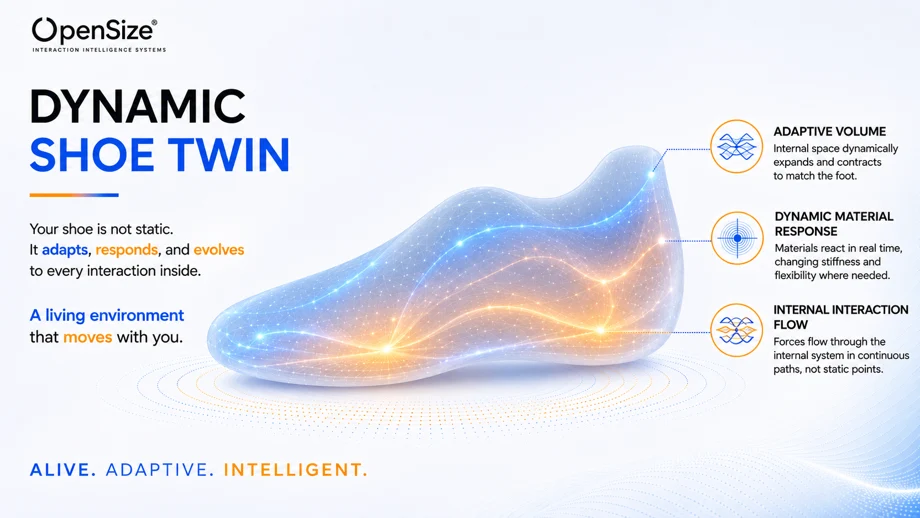
Dynamic Shoe Twin
Your shoe is not static. It adapts and responds to every interaction inside.
Adaptive volume
Internal space expands and contracts with the foot.
Dynamic material response
Materials change stiffness and flexibility under movement.
Internal interaction flow
Foot–shoe interaction develops continuously, not at fixed points.
Read slide text
OPENSIZE · 08 / 18
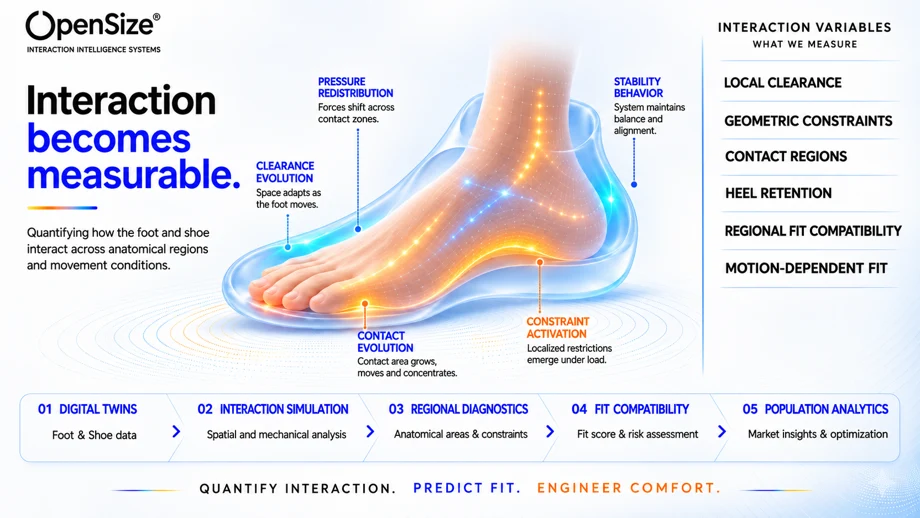
Interaction becomes measurable
Quantifying how the foot and shoe interact across anatomical regions and movement conditions.
Local clearance
Gaps between the foot and the shoe’s inner surface.
Geometric constraints
Local restrictions created by the interaction of geometries.
Contact regions
Contact areas across anatomical zones.
Heel retention
Geometric conditions for heel stability.
Regional fit compatibility
Fit compatibility in functional foot regions.
Motion-dependent fit
How fit characteristics change through movement.
Read slide text
OPENSIZE · 09 / 18
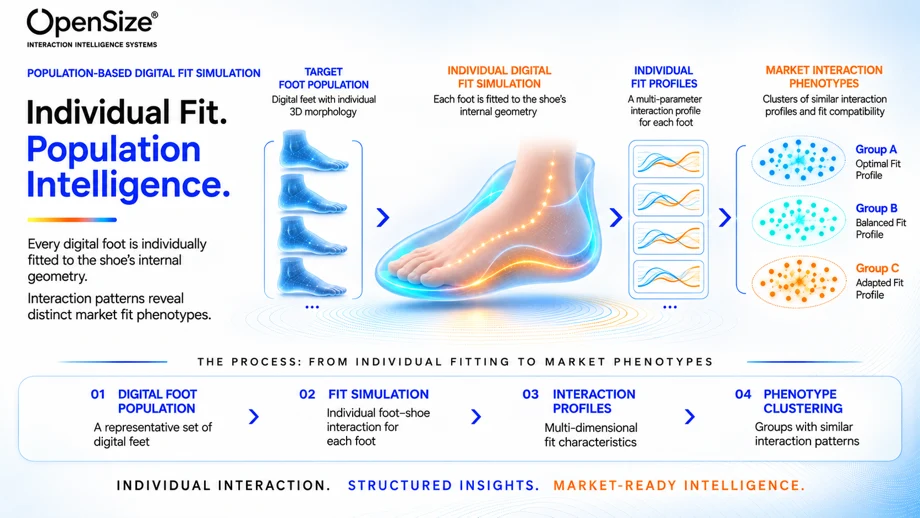
Individual Fit. Population Intelligence.
Every digital foot is individually fitted to the shoe’s internal geometry. Interaction patterns reveal distinct market fit phenotypes.
Target foot population
Digital feet with individual 3D morphologies.
Individual digital fit simulation
Each foot is fitted to the shoe’s internal geometry.
Individual fit profiles
A multi-parameter interaction profile for each foot.
Market interaction phenotypes
Groups of similar interaction profiles and fit compatibility.
Read slide text
OPENSIZE · 10 / 18
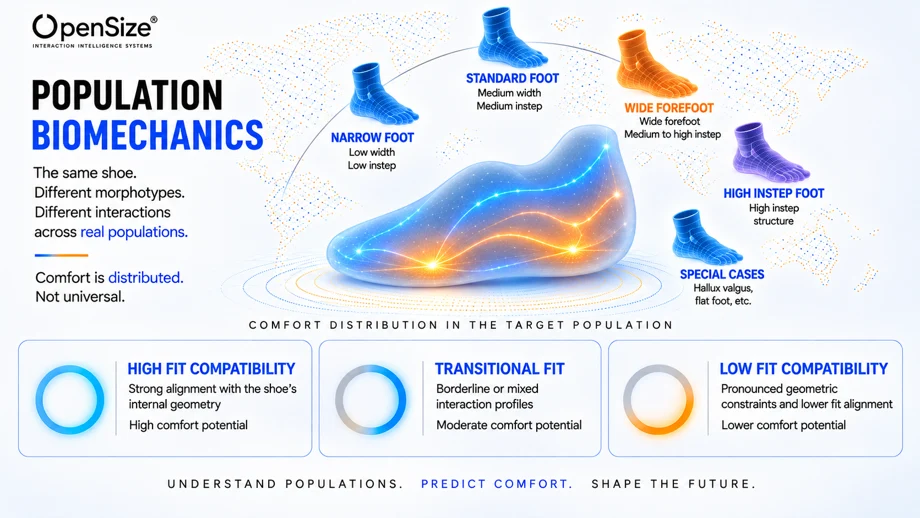
Population Biomechanics
The same shoe. Different morphotypes. Different interactions across real populations.
Foot morphotypes
Narrow foot · standard foot · wide forefoot · high instep · special cases.
High fit compatibility
Strong alignment with the shoe’s internal geometry.
Transitional fit
Borderline or mixed interaction profiles.
Low fit compatibility
Geometric restrictions and lower fit alignment.
Market perspective
Comfort is distributed. Not universal.
Read slide text
OPENSIZE · 11 / 18
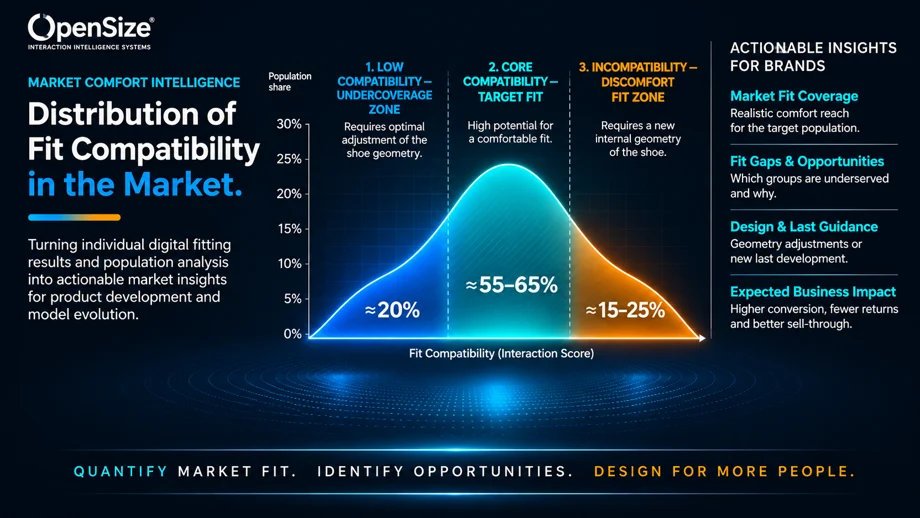
Distribution of Fit Compatibility in the Market
Individual digital fittings reveal how fit compatibility is distributed across a target market.
Low compatibility — undercoverage zone
Find underserved groups and identify geometry adjustments.
Core compatibility — target fit
Identify the population with a comfortable fit.
Incompatibility — discomfort fit zone
Determine where a new internal geometry is needed.
Insights for brands
Market Fit Coverage · Fit Gaps & Opportunities · Design & Last Guidance · Business Impact.
Read slide text
OPENSIZE · 12 / 18
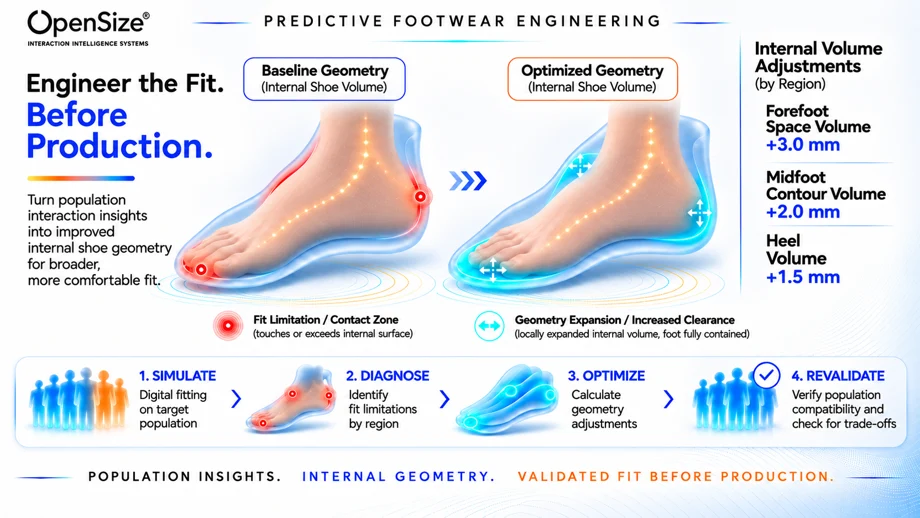
Predictive Footwear Engineering
Engineer the fit before production.
Simulate
Perform digital fitting across the target population.
Diagnose
Identify contact zones and fit limitations by anatomical region.
Optimize
Calculate internal-volume adjustments to improve local clearance.
Revalidate
Check the new geometry against the digital population.
Read slide text
OPENSIZE · 13 / 18
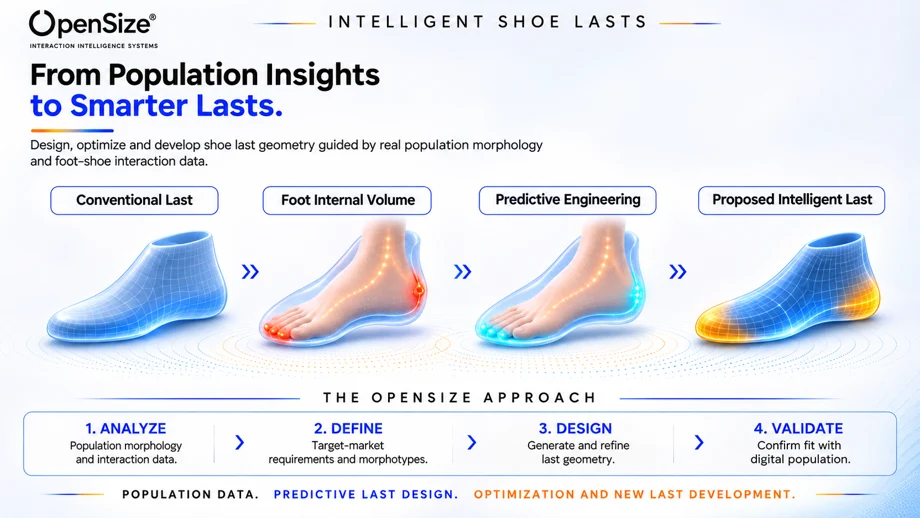
Intelligent Shoe Lasts
From population insights to smarter lasts.
Conventional Last
Start with the existing shoe-last geometry.
Foot–Internal-Volume Interaction Analysis
Identify fit restrictions inside the original shoe volume.
Predictive Engineering
Optimize the internal volume using population interaction data.
Proposed Intelligent Last
Turn the engineered internal volume into a new last design.
Read slide text
OPENSIZE · 14 / 18
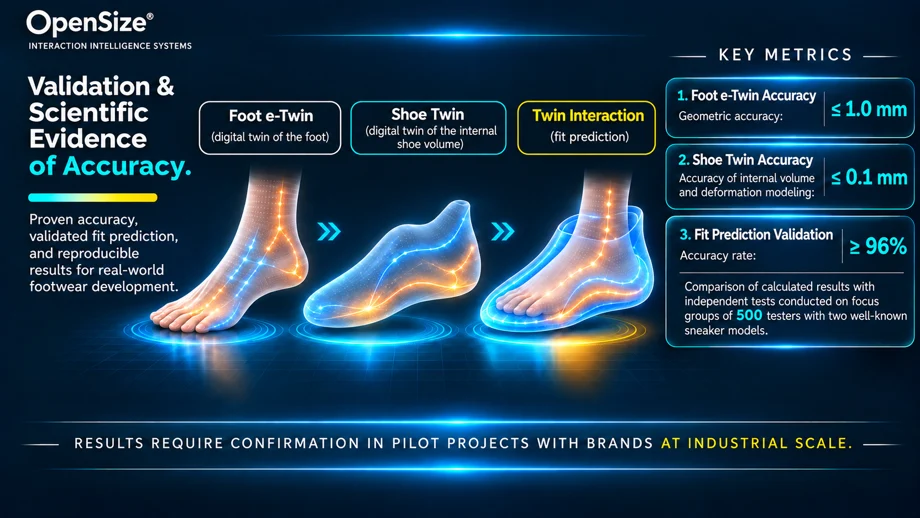
Validation & Scientific Evidence of Accuracy
Digital geometry and fit prediction supported by measured performance.
Foot e-Twin Accuracy
Geometric accuracy: ≤ 1.0 mm.
Shoe Twin Accuracy
Internal volume and deformation modeling: ≤ 0.1 mm.
Fit Prediction Validation
Accuracy rate: ≥ 96%.
Independent trials
Comparison across 500 testers and two sneaker models.
Read slide text
OPENSIZE · 15 / 18
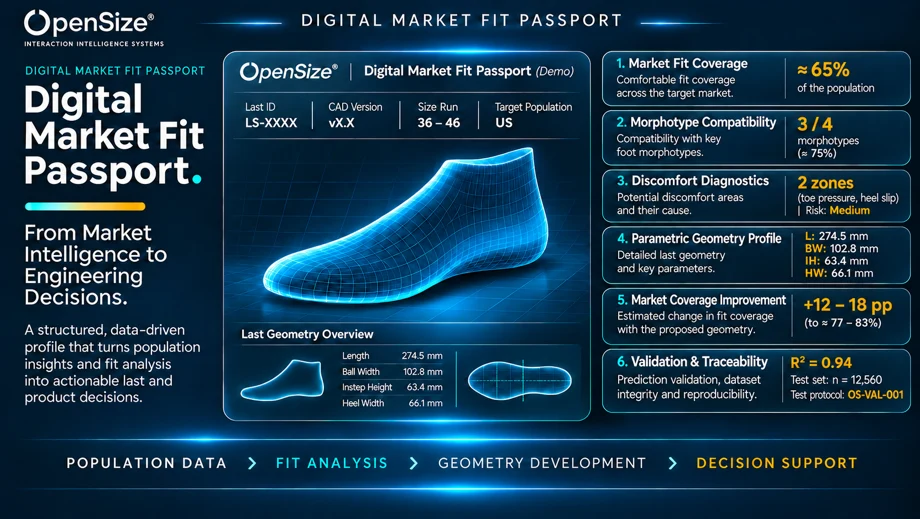
Digital Market Fit Passport
From market intelligence to engineering decisions.
Market Fit Coverage
Comfortable-fit coverage across the target market.
Morphotype Compatibility
Compatibility with the main foot morphotypes.
Discomfort Diagnostics
Fit limitations, anatomical zones and their causes.
Parametric Geometry Profile
Shoe-last geometry and key dimensions.
Market Coverage Improvement
Geometry changes that extend comfortable-fit coverage.
Validation & Traceability
Prediction validation, dataset integrity and reproducibility.
Read slide text
OPENSIZE · 16 / 18
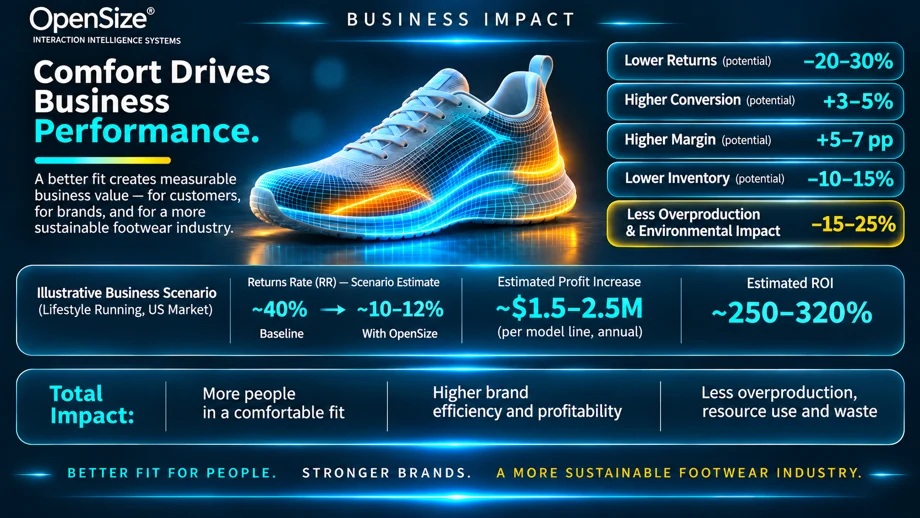
Comfort drives business performance
Better fit creates business value for people, brands and the footwear industry.
Returns
Reduce fit-related product returns.
Conversion
Connect customers with better-fitting footwear.
Margins
Improve the economics of product and inventory decisions.
Inventory
Align product development more closely with demand.
Sustainability
Reduce overproduction, resource use and waste.
Read slide text
OPENSIZE · 17 / 18
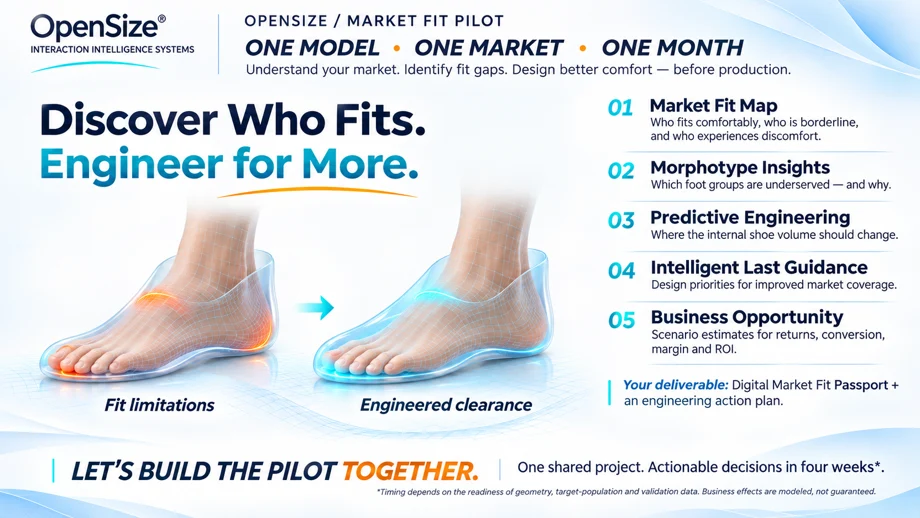
Discover Who Fits. Engineer for More.
One Model · One Market · One Month.
Market Fit Map
See who fits comfortably, who is borderline and who experiences discomfort.
Morphotype Insights
Understand which foot groups are underserved and why.
Predictive Engineering
Identify where the internal shoe volume should change.
Intelligent Last Guidance
Set design priorities for improved market coverage.
Business Opportunity
Review returns, conversion, margin and ROI for your selected market.
Your deliverable
Digital Market Fit Passport and an engineering action plan.
Read slide text
OPENSIZE · 18 / 18
Our Team
OpenSize connects research, engineering and industry partnerships.
Dr. Valery Chernik
Founder & Scientific Director
Mike Chernik
CEO & Chief Systems Architect
Serge Gavrilyuk
Chief Technology Officer
Wladimir Fischer
Director of Client Services
Andrew Lavrinovich
Co-Founder & Chief Financial Officer